
This Lean Six Sigma Yellow Belt training course is for professionals who actively participate in their organization's processes and want practical tools to understand, analyze, and improve them. More specifically, it is designed for those who must:
- Identify waste and non-value-added activities in their workplace processes
- Apply the Seven Quality Control Tools to structure problem-solving
- Calculate basic Sigma performance metrics (DPU, DPO, DPMO) to measure process quality
- Contribute effectively to DMAIC improvement projects within their team
- Drive continuous improvement initiatives in any industry or department
- Understand the foundations and history of Lean Six Sigma, including the 8 wastes (TIMWOODS)
- Apply the Seven Quality Control Tools and calculate Sigma levels (DPU, DPO, DPMO) to assess process performance
- Contribute to DMAIC improvement projects and support continuous improvement initiatives within the organization
-
- Introduction to Lean and Six Sigma
- Definitions of Lean and Six Sigma
- Belt hierarchy and the role of the Yellow Belt
- Value-added vs non-value-added activities
- History of Lean Six Sigma
- Toyota Production System and the origins of Lean
- Contributions of Shewhart and Deming
- Development of Six Sigma at Motorola and expansion at General Electric
- TIMWOODS: The 8 Wastes
- TIMWOODS acronym, Transportation and Inventory wastes
- Motion, Waiting, Overproduction and Overprocessing wastes
- Skills and Defects wastes
- Case study
- The Seven Quality Control Tools
- Check Sheet
- Pareto Chart (80/20 Rule)
- Cause & Effect (Fishbone) Diagram
- Histogram
- Control Chart
- Scatter Diagram
- Flow Chart
- Summary of the Seven Quality Control Tools
- Sigma Levels and Basic Performance Calculations
- Defects / DPU / DPO
- Defects per Million Opportunities (DPMO) and Sigma scale
- Sigma calculation use case
- DMAIC Methodology
- Define Phase (Problem statement, Voice of Customer, Project Charter)
- Measure Phase (Data collection, baseline performance)
- Analyze Phase (Root cause analysis)
- Improve Phase (Solution development, pilot testing)
- Control Phase (Standardization, monitoring, sustainability)
- Use Cases & Case Studies
- HR use case
- Finance use case
- Nunavik water and sewage truck delivery case study
- DMAIC case study
- Introduction to Lean and Six Sigma
This advanced training course is offered in English.
This training is designed for anyone who actively participates in organizational processes and has a genuine desire to understand, analyze, and improve them. As a Lean Six Sigma Yellow Belt program, it is ideal for individuals who want to develop practical problem‑solving skills, contribute to continuous improvement initiatives, and support more advanced Lean Six Sigma practitioners within their teams.
The training applies to every field where processes exist, essentially everywhere, including manufacturing, healthcare, finance, technology, services, education, and the public sector. Whether you work on the front lines or in a support role, this course equips you with the mindset and tools to make workflows more efficient, reduce waste, and drive meaningful improvements in your daily environment.
A diagnostic assessment will be conducted at the beginning of the course. Quizzes at the end of each module will assess the achievement of the learning objectives. A minimum passing score of 75% is required for these quizzes.
A final assessment will validate the overall achievement of the learning objectives.
- Exam delivery — The exam is taken online through the CFO masqué platform. Candidates log in to their account and complete the exam directly on the website.
- Type of questions — All questions are multiple choice. Each question presents four options (A–D), with one correct answer. The exam contains 20 questions.
- Marking system — Each question is worth 1 point, for a total of 20 points. There is no negative marking for incorrect answers. The exam is graded automatically by the platform upon submission, and candidates receive their score immediately. A score of 14 out of 20 (70%) or higher is required to pass.
- Number of attempts — Unlimited. Candidates may retake the exam as many times as needed until they achieve a passing score.
- Exam time — 60 minutes.
- Format — Open book. Candidates may consult their course materials, notes, and references during the exam.
- Passing score — 70%.

|
|

|
|
No prior knowledge of Lean Six Sigma or statistics is required.
Each participant must use a laptop, an Office 365 or Microsoft 365 license, and an active internet connection.
This course registration includes:
- a PDF document with all the instructions, step by step, to build your report
- the data sources for the labs
- a series of video capsules with demonstrations
- a reference website with additional resources
- a forum to ask questions
This training qualifies for 0.6 continuing education units (CEUs).
 Le CFO masqué is a member of the Société de formation et d’éducation continue (SOFEDUC), which defines a Continuing Education Unit (CEU) as 10 hours of participation in a structured training activity organized and conducted by an accredited organization, facilitated by qualified instructors and culminating in an evaluation. Only SOFEDUC members in good standing are authorized to use the graphic symbol.
Coming soon.
Coming soon.
In order to improve your Excel skills further, the next training course is: Excel – Dashboarding (level 1)
This training course is an introduction to Excel dashboarding. Your company decided to implement a dashboard in Excel, but where to start? What will you include in your dashboard? How will you structure and show your data? How will you feed your dashboard? Those are the type of questions you will be facing and those are the type of questions we will be answering.
You might also like to take a look at our training courses on creating reports and dashboards with Power BI.
To adjust the size and volume of a video, simply use the buttons shown below.
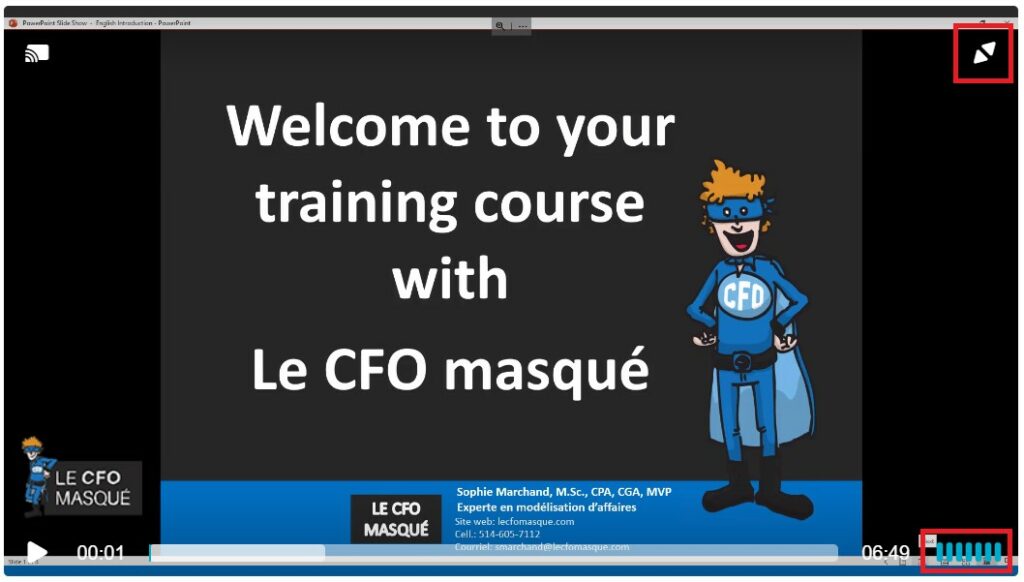
To move to the next lesson, simply click on the name of the lesson in the bottom right corner of your screen.
If you are trying to take a course that you have already purchased and are asked to purchase it again, you are logged out. Simply log back into your account and this message will disappear.
Once you have completed all the lessons and quizzes, you will see a DOWNLOAD CERTIFICATE button appear next to the course name on the course overview page. You can then click on this button to download or print your certificate of completion.
Since you have lifetime access to your training, you can listen to the videos as many times as you like. However, your certificate will only be accessible when the course is 100% complete. Therefore, before replaying a video (which will restart the counter at 0), it is strongly recommended that you download your certificate first, in order to keep a copy of it, with the original completion date.
Your e-learning course does not come with personalized help. If you have any questions, please ask them on our online forum.
You are not allowed, in any way, to share your training documents and videos with a third party, even if it is a co-worker. This clause is part of our terms of purchase and is intended to preserve our copyright. If you enjoy the content offered by Le CFO masqué, please respect this clause. This will allow us to continue to create quality material. However, we do have an affiliate program in place. Please take advantage of this program to recommend our training to your colleagues and other contacts and we will offer you a 15% commission in return.





Reviews
There are no reviews yet.